

Australia’s AI Automation Boom Is Real. The Returns Are Not.


The Investment Surge
Australian enterprises are investing in artificial intelligence at a pace that would have been unthinkable three years ago. Boards are approving AI budgets. Leaders are rewriting digital transformation strategies. Entire teams are restructuring around automation and AI initiatives.
On the surface, the momentum is undeniable. Yet beneath the optimism, the financial returns remain inconsistent.
McKinsey’s 2025 global survey, The State of AI: Agents, Innovation and Transformation, reveals a sharp contradiction. Eighty-eight percent of organisations report using AI in at least one business function. However, nearly two-thirds have not yet scaled AI across their enterprise. Only 39 percent report any EBIT impact attributable to AI, and most of those organisations attribute less than five percent of enterprise earnings to AI initiatives. What many organisations have failed to realise is that simply attaching the word “AI” to a product, process or strategy does not, in itself, create enterprise value.
The Scaling Gap
Only about one-third of organisations have begun scaling AI beyond pilots. A small cohort, representing six percent of respondents, qualify as “AI high performers” generating significant bottom-line impact.
The defining difference is not model access or experimentation volume. It is workflow redesign. McKinsey reports that high performers are nearly three times more likely to fundamentally redesign workflows rather than layer AI tools onto existing processes.
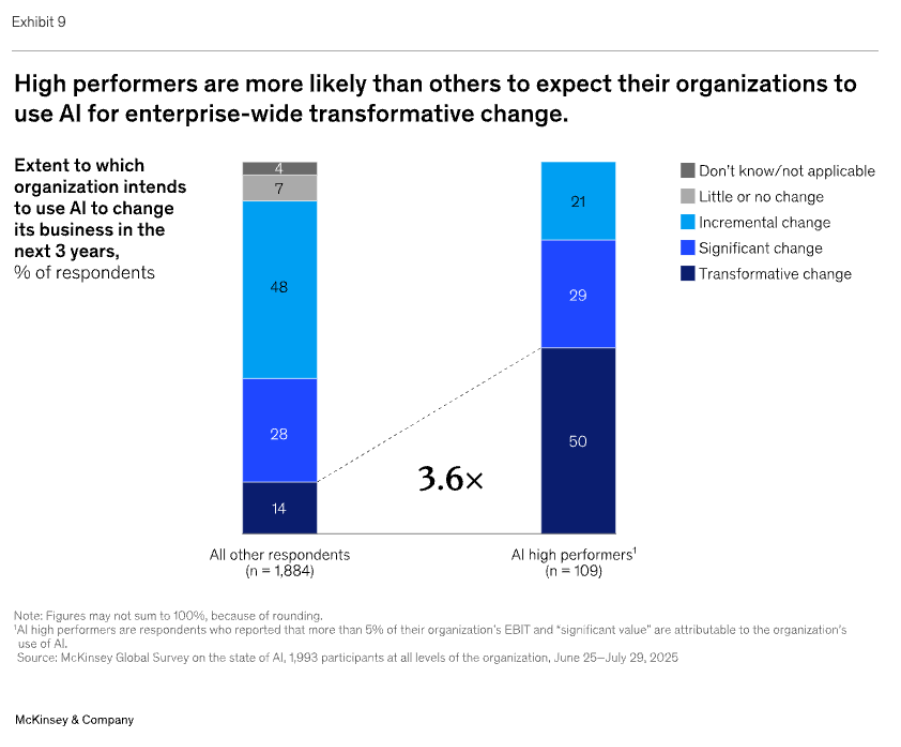
That is the structural dividing line.
Most enterprises are experimenting with AI. Very few are re-engineering their operating models around it.
When Adoption Outpaces Architecture
Australia risks repeating a familiar mistake.
Legacy automation projects often failed because teams bolted capable technology onto fragmented systems. Teams layered OCR onto paper workflows and did not rethink validation. Teams added rule engines and did not redesign downstream decisions. Efficiency improved in pockets, but the operating model remained intact.
Organisations now risk deploying generative AI in the same way.
McKinsey’s 2025 findings show that 51 percent of organisations using AI report at least one negative consequence from deployment. Inaccuracy is the most common issue. Explainability remains under-mitigated relative to the risks organisations experience.
Adoption is accelerating faster than architectural maturity.
Not every workflow requires a large language model. Not every compliance process benefits from probabilistic outputs. Some use cases require contextual semantic reasoning. Others demand symbolic logic that provides clear decision traceability. In many cases, deterministic validation remains the most appropriate approach. That is where precision and accuracy get crucial.
What High Performers Do Differently
The minority of organisations seeing meaningful enterprise impact share common behaviours.
- They redesign workflows rather than automate fragments.
- They embed governance at design stage rather than retrofitting controls.
- They track AI performance through defined KPIs.
- They treat AI as a transformation program rather than a feature deployment.
In other words, they engineer intelligence into the system.
This is where the Australian conversation must mature. The question is no longer whether organisations use AI. It is whether they apply it deliberately.
Engineering Automation with Discipline
DoxAI’s approach aligns with this architectural discipline.
Rather than defaulting to a single AI paradigm, the process begins with structured discovery.
Additionally, teams map workflow loopholes, repetitive tasks, and decision pathways. They assess compliance exposure and analyse operational friction points. They define measurable targets before implementation begins.
- Teams then select intelligence layers based on operational need.
- Teams deploy Semantic models where contextual understanding is essential.
- They apply Neurosymbolic AI approaches where explainability is critical.
- They use Machine learning where pattern detection drives measurable value.
- They keep Deterministic logic where they require control and precision.
- They introduce Generative AI where generation enhances outcomes rather than introduces unnecessary risk.
In regulated enterprise environments, this approach has delivered significant reductions in manual processing, accelerated validation cycles, and high levels of touchless workflow execution.
More importantly, teams model return on investment before deployment and measure it after implementation. As a result, this where automation becomes accountable.
Click below to learn more about DoxAI’s Intelligent Automation.
The 2026 Inflection Point
Australia’s AI automation boom is real, and investments will continue in this sector with adoption rates broadening soon. Furthermore, agentic systems will also evolve.
But McKinsey’s 2025 research makes one point unmistakable. Most organisations remain in experimentation mode. Only a small minority are capturing enterprise-level value.
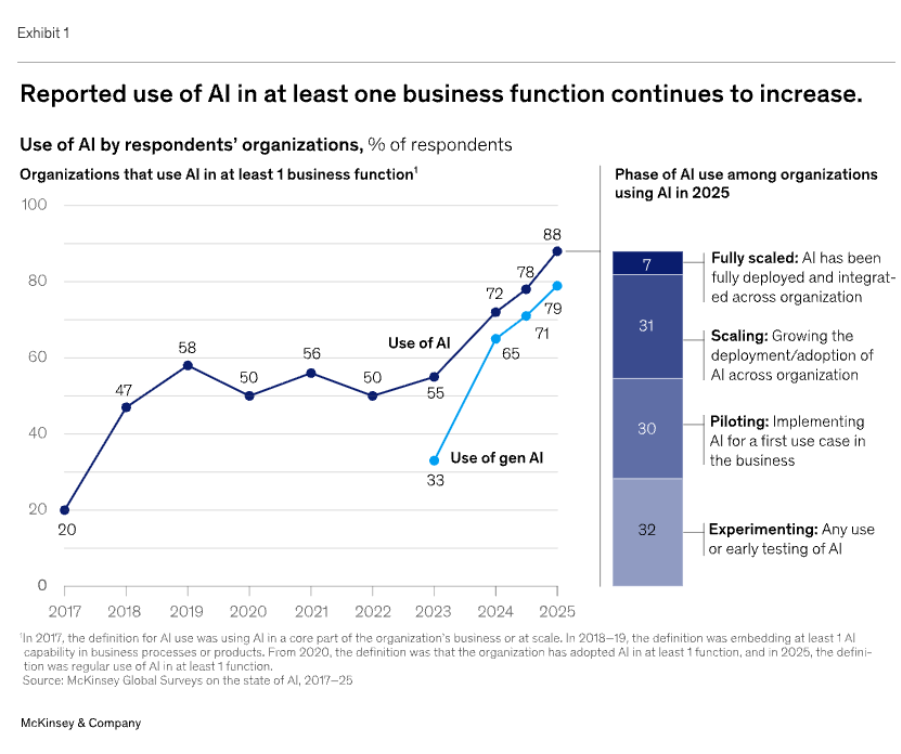
The dividing line is architectural discipline in this case.
As boards increase scrutiny on digital investment, pilot fatigue will give way to performance accountability. The next competitive advantage will belong to organisations that redesign their systems rather than decorate them with AI.
AI does not fail because it lacks power, it fails when it lacks structure.
That is the difference between hype and transformation.
If your priority is building a truly AI-ready organisation for long-term efficiency, scalability and security, book a strategy session with us.
About DoxAI
DoxAI is your trusted process automation partner, enabling to transition from outdated systems to cutting-edge AI technology. Our platform streamlines the collection, management, processing, and storage of data, enhancing security, reducing operational costs, and boosting customer engagement. DoxAI empowers providers to automate and secure every step of their data and document handling processes. Our suite of products supports end-to-end workflows, from intake to archiving, ensuring privacy, compliance and faster service delivery.
Reference:
McKinsey & Company (2025), The State of AI in 2025: Agents, Innovation and Transformation.
https://www.mckinsey.com/capabilities/quantumblack/our-insights/the-state-of-ai
Author