
How DoxAI Automates Enterprise Workflows from Discovery to AI-Native Operations


What is Workflow Automation?
Workflow automation helps organisations reduce repetitive manual work by using software to trigger, manage and monitor routine tasks. It can improve productivity, reduce human error and give teams clearer visibility across business processes. This also allows employees to spend more time on higher-value work instead of repetitive administration (Microsoft, 2026). And thus when the workflow automation is introduced and implemented to enterprises in their respective capacities, it becomes enterprise workflow automation.
According to Microsoft, workflow automation can support organisations by:
- Automating and triggering repetitive tasks.
- Improving operational efficiency and productivity.
- Identifying opportunities for process improvement.
- Monitoring workflows and performance.
- Automating reminders and notifications.
- Keeping teams and systems aligned.
- Generating actionable operational insights.
- Improving the use of people and resources.
Traditional workflow automation generally relies on predefined data inputs and rule-based logic. For example, an “if this happens, then perform that action” rule can automatically move a process to its next stage. This approach reduces manual intervention, improves consistency and lowers the risk of human error (Microsoft, 2026)
How does DoxAI execute its own AI workflow automation for Enterprise?
Enterprise workflow automation does not begin with technology. It begins with understanding how an organisation actually works.
Across financial services, government, healthcare, education and other regulated industries, many critical processes remain fragmented. Teams still rely on emails, spreadsheets, manual document reviews, duplicated data entry and disconnected legacy systems.
DoxAI takes a different approach to enterprise workflow automation. It first maps the workflow, identifies friction and then designs an AI-native operating model around the organisation.
The objective is not simply to digitise existing tasks. Instead, DoxAI connects automation, AI agents, governance, models and enterprise systems into one coordinated workflow.

1. Discovery: Understanding the Workflow
The first stage is discovery.
DoxAI maps how information, documents, decisions and approvals move across the organisation. This includes the people, systems and external data sources involved in each process.
For instance, a lending workflow may include processes for onboarding such as document collection, identity verification, income assessment and fraud detection. It may then continue through cross-document validation, decisioning, eSignature and secure storage.
During discovery, DoxAI identifies where delays, duplicated work and control gaps occur. This prevents organisations from simply automating an inefficient process.

2. Assess: Finding Manual Work and Risk
Once the process or workflow is understood, DoxAI assesses where automation can create the greatest value.
Common friction points include manual document collection, repeated data entry and inconsistent reviews. Fragmented approvals and limited audit trails can also create unnecessary risk.
Document-heavy processes are particularly difficult to scale manually. Employees may spend hours opening PDFs, extracting information, checking documents and escalating exceptions.
DoxAI can apply different AI capabilities at these points.
Extract AI structures information from documents. Fraud Check AI detects manipulation and suspicious document creation. Cross Check AI validates information across documents, systems and datasets.
Redact AI protects sensitive information. Identity Verification supports secure onboarding. eSignature and eVault can then complete execution and secure storage.
As a result, the assessment identifies both operational savings and stronger controls.

3. Tailor: Designing the Right AI Workflow
Every enterprise has different policies, risk thresholds and approval rules. Therefore, DoxAI does not impose a generic automation model.
A lender may want to identify manipulated income documents or unusual transaction patterns. An insurer may need to validate invoices and repair quotes before approving claims.
Government agencies may require identity verification, secure data collection and complete audit trails. Fund services organisations may need automated classification, extraction and validation across thousands of regulated documents.
DoxAI configures the workflow around those requirements.
That can include automated document collection, customer communications, extraction, verification and fraud detection. It can also include human approvals, agent orchestration, decisioning, eSignature and secure storage.
Importantly, automation does not remove control. Instead, it makes controls more consistent, traceable and auditable.
4. Streamline: Connecting Systems and Data
Many enterprises already have the technology they need. The problem is that those systems often operate separately.
Customer information may sit inside a CRM. Documents may remain in email inboxes. Approval data may live in spreadsheets or legacy applications.
DoxAI connects these processes through APIs, integrations and configurable workflows.
This creates a more unified operating model without requiring every existing system to be replaced.
For example, document collection can trigger extraction automatically. Fraud Check AI can then assess the documents before Cross Check AI validates the information.
The workflow can continue through approval, eSignature and eVault without repeated manual handoffs.
This is where AI workflow automation begins delivering value across the entire process.
5. Delivery: Implementation, Training and Adoption
Automation only creates value when people understand and trust it.
DoxAI therefore supports workflow configuration, testing, implementation and training. Teams learn how automated checks work and when exceptions require human review.
Operations leaders gain greater visibility into processing and performance. Compliance teams gain clearer auditability and more consistent controls.
Customers also benefit because they face fewer repeated requests and unnecessary delays.
The result is automation that becomes part of everyday operations rather than another disconnected technology project.
From Workflow Automation to an AI-Native Enterprise
DoxAI’s new offering extends this workflow approach beyond individual automation products.
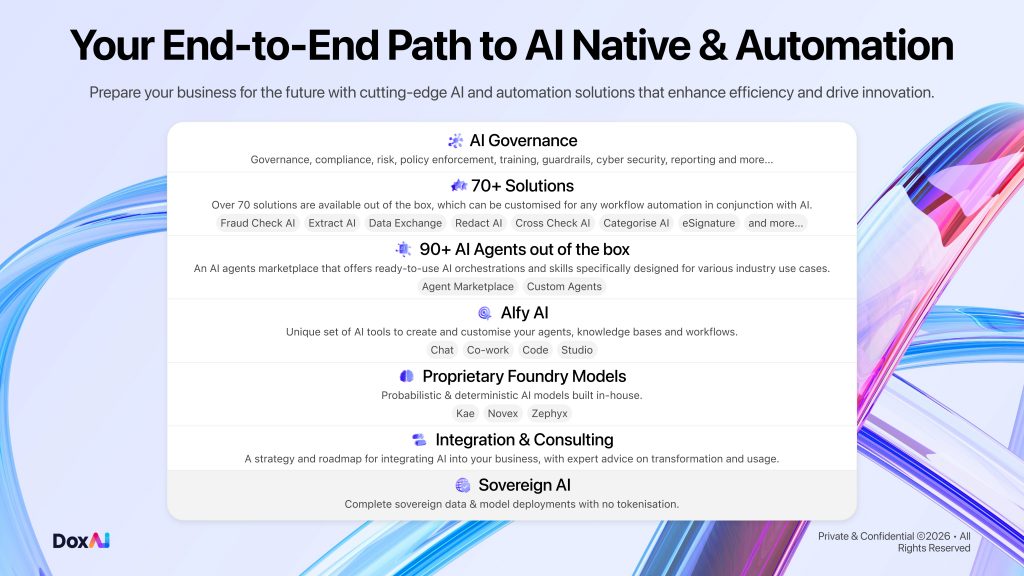
The platform now brings together AI Governance, 70+ automation solutions, 90+ AI agents, Alfy AI, proprietary AI models, integration services and Sovereign AI.
Together, these capabilities create an end-to-end path towards becoming AI-native.
AI Governance
DoxAI places governance above the automation layer.
This covers risk, compliance, policies, guardrails, cybersecurity, training and reporting. Governance defines how AI can operate across the enterprise.
This is particularly important for regulated organisations because greater AI autonomy requires stronger oversight.
70+ AI Automation Solutions
DoxAI provides more than 70 solutions across enterprise data and document workflows.
These include Fraud Check AI, Extract AI, Data Exchange, Redact AI, Cross Check AI, Categorise AI and eSignature.
The solutions can operate independently or as part of larger automated workflows.
90+ Enterprise AI Agents
DoxAI also provides more than 90 ready-to-use AI agents.
These agents support AI orchestration, industry-specific processes and repeatable enterprise tasks. Custom agents can also be designed around specific organisational requirements.
This allows organisations to progress from task automation towards agentic AI workflows.
What Is Alfy AI?
Alfy AI is DoxAI’s enterprise AI environment for interacting with, building and orchestrating AI across business workflows.
It includes four core capabilities:
- Alfy AI Chat supports enterprise conversations, projects, memory, skills and connected knowledge.
- Alfy AI Cowork supports planned and autonomous task execution across enterprise processes.
- Alfy AI Code supports software development, code analysis and technical workflows.
- Alfy AI Studio allows organisations to create agents, knowledge bases, workflows and enterprise AI applications.
Together, these capabilities extend DoxAI from process automation into a broader enterprise AI operating environment.
Proprietary Foundry Models
DoxAI is also developing proprietary AI models designed for enterprise use.
The current Foundry model family includes Kae, Novex and Zephyx.
These models combine probabilistic AI with deterministic controls. That approach is particularly relevant when AI must operate alongside fixed business rules and compliance requirements.
Sovereign AI
DoxAI’s Sovereign AI architecture gives organisations greater control over their data, models and AI infrastructure.
Deployment options can include DoxAI Cloud, private VPC environments and on-premise infrastructure.
Organisations can maintain control over data retention, encryption keys and model deployment. Customer information can also remain outside shared model training.
For regulated enterprises, sovereign AI provides another layer of control over how AI operates.
Why DoxAI’s Enterprise Workflow Automation Model Matters
The core problem with enterprise automation is rarely one isolated task.
A document collection issue may also create data quality problems. Fraud risk may also expose weaknesses in validation and approval processes.
Likewise, poor customer experience often begins with fragmented internal systems.
DoxAI addresses the entire workflow.
Its approach moves through discovery, assessment, tailoring, streamlining and delivery. The new AI-native architecture then extends those workflows through governance, agents, proprietary models and sovereign infrastructure.
This creates a clear path from manual processes to governed enterprise workflow automation powered by AI.
The outcome is faster processing, stronger controls and less manual work. More importantly, organisations gain greater confidence in how AI operates across critical business processes.
About DoxAI
DoxAI is the automation partner for enterprises ready to become AI-native. We replace outdated systems and fragmented workflows with one intelligent automation layer unifying the collection, management, processing, and storage of data and documents to deliver stronger security, lower costs, and better customer experiences at scale.
DoxAI brings together AI Governance, 70+ automation solutions, 90+ AI agents, Alfy AI, Proprietary Foundry Models, integration and consulting, and Sovereign AI.
Its platform enables enterprises to move from isolated AI tools towards governed, connected and AI-native operations.
Author