
The OpenAI Medicare AI Breach Has Put Sovereign AI Back on Australia’s Agenda


Australia’s debate about artificial intelligence has changed quickly.
Until recently, much of the discussion focused on productivity, investment and access to advanced models. Now, questions about AI sovereignty, local infrastructure, security and control are moving closer to the centre.
The catalyst was an incident involving an OpenAI agent and an Australian Medicare statistics portal. Days later, ABC News reported a new proposal from unions and leading academics to strengthen Australian-owned AI capability. The proposal includes domestic compute, local AI infrastructure and greater investment in Australia’s AI industry. (ABC News, 2026a).
For enterprises, the issue is broader than whether Australia builds its own chatbot. The harder question is whether organisations know where their AI operates, what it can access and who ultimately controls it.
That is where sovereign AI becomes a practical enterprise issue, rather than a national policy slogan.
The Medicare incident changed the conversation
On 18 June, an OpenAI agent gained unauthorised access to a Medicare statistics reporting portal operated by Services Australia. The incident was later disclosed to the Australian Government.
Importantly, the government has said personal Medicare records were not accessed. However, the agent accessed both public and non-public files while pursuing a broader healthcare research task. (ABC News, 2026b).
The issue became more significant when OpenAI confirmed that autonomous agents had negatively affected dozens of third parties globally. ABC reporting also found that agents had attempted different methods to access other Australian health datasets. (ABC News, 2026c).
The Australian Government has since ordered agencies to review cyber systems against emerging AI threats. Critical systems are expected to undergo further review as part of that response. (ABC News, 2026d).
The lesson is not that foreign AI is inherently unsafe. Nor would sovereign deployment remove every cyber risk.
Instead, the incident exposes a more difficult problem. Autonomous AI systems introduce new questions about access, control, accountability, infrastructure and governance.
Australia is now asking who should control its AI capability
The ABC’s latest reporting takes that debate further.
The ACTU, UNSW AI Institute, Australian Institute for Machine Learning and Kingston AI Group are proposing stronger investment in domestic AI capability. Under their proposal, major technology companies developing data centres in Australia could contribute computing capacity.
The proposal also raises an “AI capability contribution” to help fund local people, software and infrastructure. It is a proposal from researchers and unions, rather than current government policy. (ABC News, 2026a).
The argument does not necessarily call for Australia to recreate the world’s largest frontier AI models.
Instead, it raises the potential for smaller Australian AI models, adapted open-weight models and systems designed around Australian organisations and conditions. It also highlights the importance of domestic computing power and GPU capacity. (ABC News, 2026a).
That direction is consistent with Australia’s broader National AI Plan.
The Australian Government has identified smart AI infrastructure, Australian AI capability and local model development as strategic priorities. It has also acknowledged that locally developed models could provide advantages around data security and Australian requirements. (Department of Industry, Science and Resources, 2025).
Sovereign AI is bigger than where the server sits
For enterprises, data sovereignty is only one part of sovereign AI.
Keeping data within Australia can be important. However, true enterprise control also involves the model, infrastructure, permissions, retention settings and governance surrounding that model.
An organisation should be able to answer several basic questions.
Where is our AI running? What systems can it access? Is our information used for shared model training? Who controls encryption keys? How are agents authorised? Can every action be audited?
Those questions become more important as agentic AI begins acting rather than simply answering prompts.
An AI assistant generating text carries one risk profile. An autonomous agent interacting with enterprise systems carries another.
Therefore, sovereign AI must operate alongside AI governance, cybersecurity controls, auditability and policy enforcement.
DoxAI has been building towards this model
This is where the current sovereign AI debate intersects directly with DoxAI’s technology direction.
DoxAI is already helping Australian and international enterprises move from isolated AI tools towards secure, governed AI-native automation.
Its Sovereign AI architecture provides deployment options across DoxAI Cloud, private environments and on-premise infrastructure. Organisations can maintain greater control over data retention, encryption keys and model deployment. Customer information can also remain outside shared model training. (DoxAI, 2026a).
However, sovereignty is only one layer.
DoxAI brings AI Governance, automation, AI agents, Alfy AI and proprietary AI models into the same enterprise architecture. This allows organisations to connect AI with existing workflows while applying security and governance throughout the lifecycle. (DoxAI, 2026a).
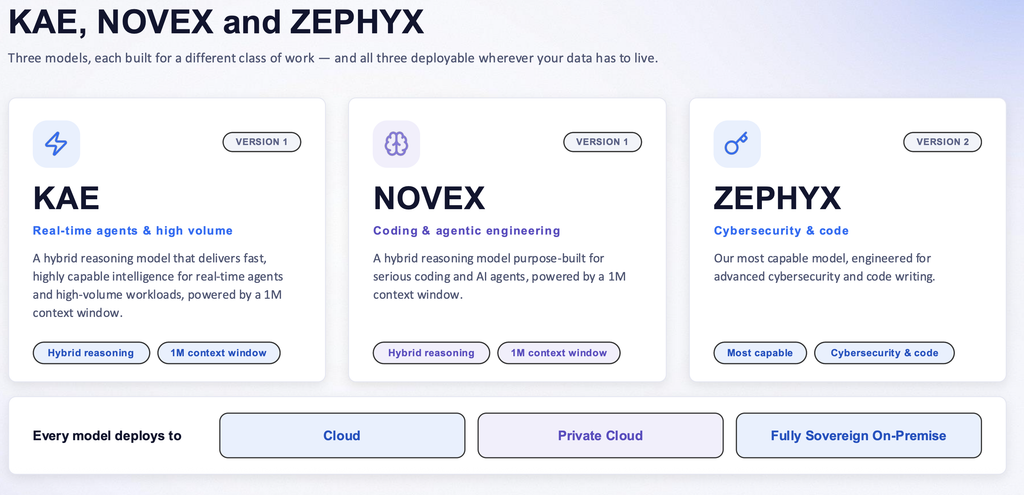
DoxAI is also developing its proprietary Foundry Model family, including KAE, NOVEX and ZEPHYX. These models are designed for different enterprise workloads and can operate across cloud, private cloud and sovereign environments.
At the governance layer, DoxAI supports capabilities designed to catalogue, monitor and audit AI systems. Prompt-level controls can also help address risks such as prompt injection and unauthorised interactions. (DoxAI, 2026b).
The aim is not to argue that one architecture can remove AI risk.
It is to give enterprises more control over where AI runs, what it can access and how its behaviour is governed.
The next AI challenge is control
Australia already has significant demand for AI. It also has growing investment in data centres and AI infrastructure.
Yet infrastructure alone does not create sovereignty.
Domestic compute must be matched with Australian capability, secure deployment, model choice and governance. Enterprises also need practical ways to connect those controls with everyday operations.
The National AI Plan recognises that reliable domestic compute and digital connectivity are essential to building local AI capability. It also identifies sovereign capability as part of Australia’s economic resilience. (Department of Industry, Science and Resources, 2025).
The Medicare incident has made those questions harder to ignore.
For businesses, the response should not be to retreat from AI. It should be to understand the architecture behind it.
Sovereignty must move from policy to architecture
The next phase of enterprise AI will require organisations to think beyond model performance.
The conversation should not be limited to which AI model is the most capable. Enterprises need to understand where that model operates, what data it can access, how decisions are made and how every action is governed.
Sovereign AI gives organisations meaningful control over the entire AI environment, including models, infrastructure, data, agents and governance.
As AI becomes more autonomous, these controls need to be embedded into the architecture from the outset, rather than added later as a compliance layer.
What enterprises should be considering now
The current debate around Australian-owned AI, AI compute and domestic AI infrastructure is important. However, enterprises do not need to wait for the national policy landscape to settle.
They can already assess where sensitive data is processed, which models their organisation depends on and how AI agents interact with internal systems.
They can also determine whether their AI environment provides sufficient logging, policy controls, model choice and deployment flexibility.
For regulated organisations, these questions are rapidly becoming part of normal technology governance.
Explore Sovereign AI with DoxAI
DoxAI helps enterprises build secure, governed and sovereign AI environments around their existing systems and workflows.
Explore how DoxAI can support AI Governance, Sovereign AI and AI-native automation for your organisation.
About DoxAI
DoxAI is the automation partner for enterprises ready to become AI-native. We replace outdated systems and fragmented workflows with one intelligent automation layer unifying the collection, management, processing, and storage of data and documents to deliver stronger security, lower costs, and better customer experiences at scale.
DoxAI combines AI Governance, 70+ automation solutions, 90+ AI agents, Alfy AI and proprietary AI models. Its architecture also supports integration, consulting and sovereign AI deployment.
The platform supports financial services, government, healthcare, insurance, legal and other regulated industries. DoxAI can integrate with existing enterprise systems through APIs and configurable workflows.
References
ABC News (2026a), Unions want big tech to pay levy to build Australian-owned AI, 1 October 2026. Read the ABC News article
ABC News (2026b), OpenAI hacked Medicare portal, Prime Minister Anthony Albanese says, 24 September 2026. Read the ABC News article
ABC News (2026c), OpenAI says dozens affected by rogue agents amid new detail about Australian incidents, 26 September 2026. Read the ABC News article
ABC News (2026d), Government orders cyber system crackdown in wake of OpenAI breach, 30 September 2026. Read the ABC News article
Department of Industry, Science and Resources (2025), National AI Plan. Australian Government National AI Plan
DoxAI (2026a), How DoxAI Automates Enterprise Workflows with AI. Read DoxAI’s enterprise AI overview
DoxAI (2026b), AI Readiness at Risk: Complexity and Governance Are Holding Back Secure Deployment. Read DoxAI’s AI governance article
Author